How Planning Helped Me Cope During Fertility Treatment
The Story Behind What I Can Control
A printable fertility planner to help you build healthy habits and emotional boundaries while trying to conceive.
When we decided to seek fertility treatment, I actually felt relieved.
After years of guessing, I finally thought:

Woman planning healthy habits while trying to conceive with a printable fertility planner..png
"Now I'm in the hands of experts. They'll tell me everything I need to do."
In my mind, the clinic would do everything.
Then reality arrived.
Not because anyone had done anything wrong, but because I hadn't understood what a fertility clinic actually does.
Their job is to investigate and carry out fertility treatment. They aren't there to manage every aspect of your life and health.
While we were on the waiting list, I also discovered that I needed to manage some metabolic and hormonal health conditions alongside my fertility treatment. Suddenly, I found myself working with an endocrinologist as well as my fertility clinic.
Then came another feeling I know many women will recognise.
"If I'm investing so much emotionally, physically and financially into fertility treatment, I want to do everything reasonably within my power."
If I'm honest, I was trying to be perfect.
So I started making a plan for my nutrition, exercise, sleep, appointments and the many small decisions that suddenly felt important.
And something unexpected happened.
Instead of becoming more anxious, I became calmer.
Not because I suddenly believed treatment would work.
But because I knew that each day I was doing everything that was reasonably within my power.
I stopped asking myself:
"What else should I be doing?"
"What if it isn't enough?"
"What if it doesn't work?"
Those questions never disappeared completely.
But they no longer filled every spare moment of my day.
I had made my decisions.
I had my plan.
I was busy living it.
I knew I was doing everything I possibly could.
And for the first time, I felt able to leave the rest to unfold as it would.
Years later, I discovered that psychologists had been studying something very similar for decades.
I didn't know the research then.
I only knew how it felt.
Eventually, I realised that what had helped me most wasn't another supplement or another article.
It was having one place where everything lived.
My plans.
My routines.
My reflections.
The difficult days.
The hopeful days.
It also reminded me to check in with myself emotionally, so I didn't become either a routine robot ticking boxes or an anxiety ball consumed by "what ifs."
That's why I created What I Can Control.
Not because planning changes the outcome.
But because it changed how I experienced my journey.
If it helps another woman feel even a little calmer during one of the most uncertain periods of her life, then creating it will have been worth it.
What I Can Control
A guided companion for building healthy habits and emotional boundaries while trying to conceive.
If this story resonates with you, I'd love to share the planner that grew from it.
Inside you'll find:
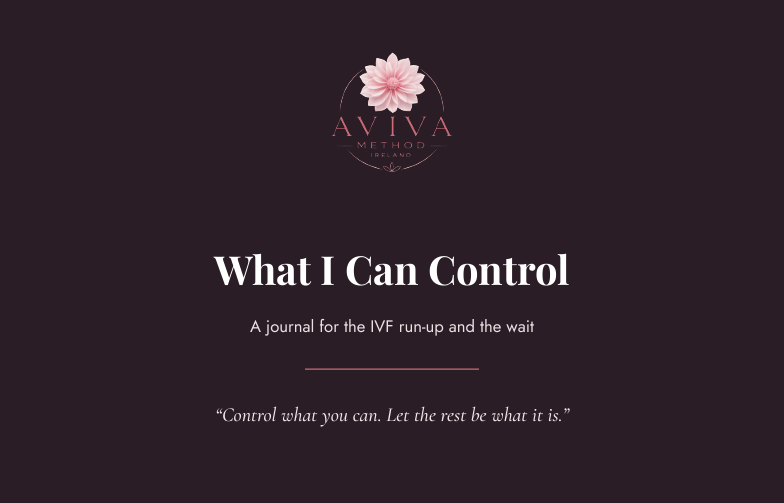
What I Can Control
Weekly planning pages
Daily check-ins
Lifestyle planning
Reflection exercises
An Information Diet exercise
Brain dump pages
Support for difficult days
Gentle reminders to focus on what you can control rather than what you cannot
Why Did It Help?
Years later, I discovered that psychologists have been studying something very similar for decades.
Research suggests that identifying meaningful actions we can take during uncertain situations can strengthen our sense of control and support emotional wellbeing. Concepts such as perceived control, self-efficacy and problem-focused coping all point in a similar direction: while we cannot control every outcome, having realistic actions within our control can make uncertainty easier to navigate.
For me, that was exactly what planning made possible.
Self-efficacy can support emotional wellbeing
Self-efficacy describes our confidence in our ability to carry out the behaviours we have chosen.
Researchers have developed an Infertility Self-Efficacy Scale, and studies have examined the relationship between infertility self-efficacy and emotional adjustment during treatment.
For me, planning helped turn a large and overwhelming intention—"I want to do everything I reasonably can"—into actions I could actually follow.
Focusing on controllable actions can reduce helplessness
None of us can control whether treatment will be successful.
But we can decide how we care for ourselves today.
We can decide which habits are realistic.
We can decide where to look for information.
We can decide what emotional boundaries we need.
We can decide when to rest.
For me, that was what planning made possible.
Related Articles
References
Bandura A. Self-Efficacy: The Exercise of Control. W.H. Freeman; 1997.
Cousineau TM, Green TC, Corsini E, et al. Development and validation of the Infertility Self-Efficacy Scale. Fertility and Sterility. 2006.
Gourounti K, Anagnostopoulos F, Potamianos G, et al. Associations between perceived control, coping and psychological adjustment in women undergoing fertility treatment.
Lazarus RS, Folkman S. Stress, Appraisal, and Coping. Springer Publishing; 1984.
Medical Disclaimer
The information in this article and in What I Can Control is provided for educational and informational purposes only. It reflects my personal experience alongside evidence from published research and should not be interpreted as medical advice.
Every fertility journey is different. Decisions about fertility treatment, nutrition, exercise, supplements or medications should always be made in consultation with your fertility specialist or other qualified healthcare professionals who understand your individual circumstances.
Using What I Can Control is not intended to diagnose, treat, cure or prevent any medical condition. Rather, it is a tool designed to help you organise your thoughts, build supportive habits and navigate the emotional challenges that can come with trying to conceive.
Ready to try the Aviva Method?
You can learn with me online from wherever you are. If you don’t have an Aviva instructor available where you live, you are very welcome to join.
Not sure which option is right for you? Write to me.
Not ready yet? Watch the videos or follow @aviva_fertility to see more of the method first.